

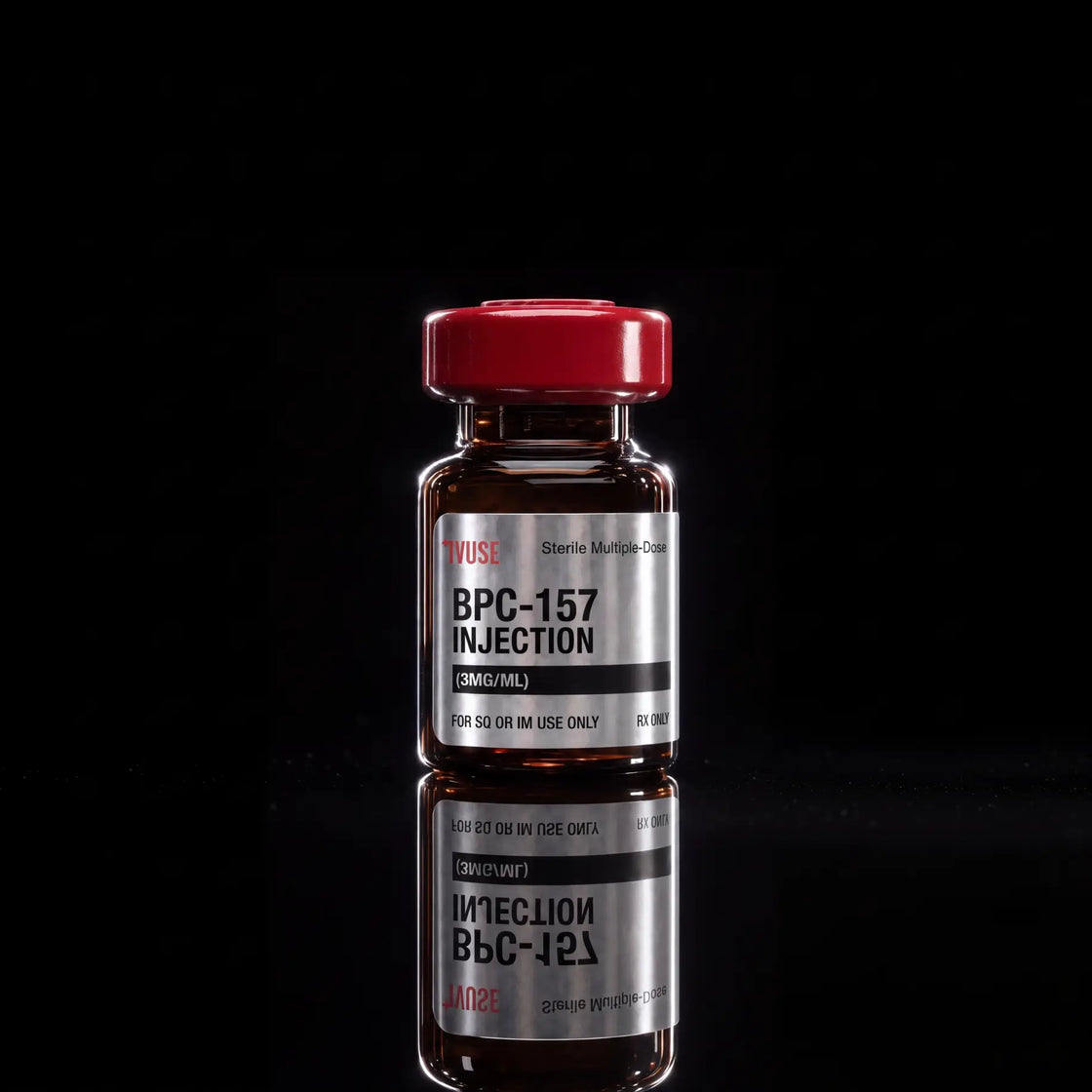
IVUSE+ does not manufacture compounded medications. Actual product appearance and labeling of the medication you receive will differ from website images.
BPC-157.
BPC-157. A fifteen-amino-acid peptide derived from human gastric juice that survives enzymatic destruction and activates four parallel repair pathways. The repair signal, delivered directly.
*Clinician-prescribed. Ships from a licensed U.S. pharmacy.
The formulation.
| Peptide | BPC-157 (Body Protection Compound-157) |
| Derived From | Synthetic pentadecapeptide, human gastric juice sequence |
| Concentration | 3 mg/ml |
| Format | Sterile injectable solution |
| Route | Subcutaneous |
| Pharmacy | Licensed U.S. Compounding Pharmacy |
Most peptides marketed for tissue repair target a single mechanism. BPC-157 runs four in parallel: VEGFR2-driven angiogenesis, dual-pathway nitric oxide modulation, FAK-paxillin fibroblast migration, and growth hormone receptor upregulation in connective tissue. The result is coordinated repair, not isolated improvement. Tendons, gut lining, and vascular tissue respond simultaneously because the signaling reaches all three at once.
The mechanism
The Repair Signal That Survives Everything.
Most peptides are destroyed within minutes by proteolytic enzymes. BPC-157 survives human gastric juice for over 24 hours. It evolved in the most proteolytically hostile environment in the body and emerged stable enough to function as a persistent repair signal in any tissue it reaches.
Four pathways operate in parallel. VEGFR2 activation builds new blood vessels at injury sites by sensitizing endothelium to existing growth factors. Dual nitric oxide modulation (Akt-eNOS and Src-Caveolin-1-eNOS) drives vasodilation and endothelial stability. FAK-paxillin phosphorylation mobilizes fibroblasts to the damage site. GHR upregulation sensitizes connective tissue to circulating growth hormone. One peptide coordinating angiogenesis, cell migration, receptor sensitization, and survival signaling simultaneously.

Complete your intake
No appointments. No waiting rooms.
Your prescription ships
Compounded by a licensed U.S. pharmacy. Cold-shipped.
Run the course
Follow your provider's dosing schedule.
Safety
What to expect+
BPC-157 has a favorable safety profile across over 100 preclinical studies. No lethal or toxic dose has been identified.
A 2025 human pilot study of IV BPC-157 at doses up to 20 mg produced no adverse effects.
Common injection-related effects include mild site soreness and occasional nausea during initial dosing.
Who should not use this+
Do not use if you are pregnant or breastfeeding.
Do not use if you have active cancer. BPC-157 promotes angiogenesis, which may theoretically support tumor vascularization.
Do not use if you have chronic kidney disease or untreated cardiovascular conditions.
Not intended for individuals under 18.
Should be cycled or used under medical supervision, especially long-term.
Regulatory context+
BPC-157 is a compounded formulation prepared under section 503A in a licensed U.S. compounding pharmacy. It requires a prescription from a licensed healthcare provider.
Frequently asked
What is BPC-157?+
BPC-157, short for Body Protection Compound 157, is a synthetic peptide of fifteen amino acids first isolated from a protective protein in human gastric juice. Its sequence doesn't match any other known peptide, and it's notably stable, surviving gastric juice for over 24 hours. It's studied mainly as a repair signal for soft tissue and the gut.
How does BPC-157 work?+
It works through four repair pathways running in parallel. It supports new blood vessel formation, modulates nitric oxide signaling, helps mobilize the cells that rebuild tissue, and sensitizes connective tissue to growth hormone. Rather than producing one isolated effect, these pathways work together, so what you're getting is coordinated repair.
What can I expect from BPC-157?+
Many people use it for help with tendon and ligament recovery, which is its most documented area, and it may also support the gut lining. Because it helps build vascular infrastructure at injury sites, some find it useful for overall recovery. That said, results vary, so what you notice may differ from someone else.
Are there any side effects?+
BPC-157 has a favorable safety profile across more than 100 preclinical studies, and no lethal or toxic dose has been identified. A 2025 human pilot study reported no adverse effects, and common injection-related effects are mild site soreness and occasional nausea early on. If you have an active malignancy, it's worth consulting your oncologist because of BPC-157's pro-angiogenic properties.
How is BPC-157 made and shipped?+
It starts with a short online medical intake, and if it's a fit, a licensed U.S. provider writes the prescription. From there it's compounded at a licensed 503A pharmacy and batch tested by a third party for sterility and potency. Then it's shipped cold-packed right to your door.
What's the best way to buy BPC-157?+
You've got two options. You can buy a one-time single vial, or you can go with the Build Your Stack subscription, which lets you mix and match the compounds in your monthly stack, starting at $189 per month. For ongoing use the stack is the better value, and you can pause, skip, or cancel anytime.
A short course of work. Your cells carry it from there.
$220.00 · Clinician-prescribed · Ships from a licensed U.S. pharmacyThese statements have not been evaluated by the Food and Drug Administration. This product is not intended to diagnose, treat, cure, or prevent any disease. Prescription products require an online consultation with a licensed provider who will determine if a prescription is appropriate.