

How Long These Take To Work, And What They Won't Do
Realistic Timelines For Every Category On The Shelf
Medically reviewed by IVUSE+ Clinical Team
Week three is where most protocols die.
The vial arrived. The injections went fine. The routine held. And then somewhere around day nineteen a woman stands in front of a mirror in decent light, looks at a face and a body doing exactly what they were doing on day one, and thinks: this isn't working.
Sometimes she's right. More often she's evaluating a twelve-week process at week three, using the only timeline anyone ever gave her, which came from an ad.
That's the real failure mode in this category. Not bad molecules. Mismatched expectations. Someone bought a copper peptide expecting a filler result, or bought a nootropic expecting Adderall, or bought a GLP-1 expecting body composition and got weight loss instead, which is a related but different thing.
So here's the version we'd give you across a table, before you spend anything.
Quick answer: what does each category do?
IVUSE+ carries three categories, and they solve different problems.
GLP-1 medications (compounded semaglutide and tirzepatide, the active ingredients in Ozempic, Wegovy, Mounjaro, and Zepbound) act on appetite and gastric emptying. They handle what goes in. This is the only category here with large-scale human trial data behind it.
Peptides are short amino acid chains that work as signaling molecules on specific pathways: growth hormone release, tissue repair, collagen production, cognitive function, arousal. They don't touch appetite. They handle narrow, specific jobs.
Injectable supplements are vitamins, amino acids, and cellular cofactors delivered subcutaneously to skip gut absorption. They correct a gap. They don't create an advantage where no gap exists.
None of the three replaces the others, and none replaces protein, sleep, resistance training, or sunscreen. What each one does is amplify a process already running. If nothing's running, there's nothing to amplify.
How long before you can judge it
- Days: cognitive peptides (SEMAX, SELANK). PT-141 works the same session.
- 2 to 4 weeks: repair peptides (BPC-157, TB-500), deficiency correction, first sleep changes on secretagogues.
- 6 to 12 weeks: GLP-1 scale movement. Skin on GHK-Cu needs the full 8 to 12.
- 3 to 6 months: body composition on growth hormone secretagogues.
- 6 months: honest evaluation of a GLP-1, because you spend the first 4 to 5 titrating.
Key takeaways
- GLP-1s are the only category here with large randomized human trials behind them. Everything else sits on thinner evidence, and we'll tell you how thin.
- Peptides work on narrow pathways. Buying one expecting broad results is the most common and most expensive mistake in this category.
- Injectable supplements produce a noticeable effect mainly when they're correcting a real deficiency. Get labs first.
- Peptides and injectables are a flat 30-day supply, paid once. No subscription, no auto-renewal. GLP-1 pricing is flat-rate and doesn't move as your dose goes up.
The three tiers of evidence
Not everything in this catalog carries the same weight of proof. We sort our own shelf internally, and you should see the same sort we use.
Tier 1. Large randomized human trials. You know roughly what happens, and to how many people.
Tier 2. Real human data, narrow scope. Small, short, single-population, or measuring a biomarker instead of an outcome.
Tier 3. Mostly preclinical. Animal and cell research, a well-described mechanism, decades of published data in some cases, plus clinical experience and user report. The human outcome trials aren't there.
Most peptides on every market, ours included, sit in Tier 3. That doesn't make them worthless. It makes the honest answer to "will this work for me" a probability rather than a promise.
The ceiling matters as much as the benefit.
GLP-1 medications: the appetite lever
Compounded Semaglutide, Compounded Tirzepatide. Semaglutide is the active ingredient in Ozempic and Wegovy. Tirzepatide is the active ingredient in Mounjaro and Zepbound. Same molecules, compounded formulation.
Evidence: Tier 1. The most heavily studied category on this shelf by a wide margin.
What to expect
Appetite changes show up fast, usually inside the first two weeks. Food noise drops. The negotiation you'd been having with yourself three times a day mostly stops.
Scale movement follows between weeks 6 and 12. In the registration trials, semaglutide averaged 14.9 percent of starting body weight over 68 weeks (STEP-1), and tirzepatide averaged around 20.9 percent at its highest dose over 72 weeks (SURMOUNT-1). Those were separate trials, so the numbers were never strictly comparable.
They have since been compared directly. SURMOUNT-5, published in 2025, put the two head to head in adults with obesity and without diabetes: tirzepatide averaged 20.2 percent versus 13.7 percent for semaglutide at 72 weeks. That is the only head-to-head data that exists, and it is worth more than any indirect comparison of the two original trials.
You won't be at full dose quickly, because titration is monthly and rushing it produces nausea rather than results. Budget four to five months just to arrive at the dose those trials were measuring.
What it won't do
It won't preserve your muscle. Somewhere between a quarter and 40 percent of what comes off can be lean tissue if you aren't lifting and eating enough protein. This is the most ignored fact in the category, and it's the reason a woman can lose thirty pounds and dislike the result.
It won't hold after you stop. In the semaglutide extension data, participants regained roughly two thirds of what they'd lost within a year of stopping. Plan for maintenance dosing or plan for regain. Those are the two options.
It won't recompose you. It's a weight tool. Weight and shape are different projects, and the second one usually starts around the time the first one plateaus.
It won't resolve why you eat. If food is doing emotional work, turning down appetite tends to surface that rather than solve it.
See GLP-1 details and pricing Flat-rate, dose-independent, telehealth and shipping included.
Peptides: Slim + Shred
Tesamorelin, AOD-9604, Ipamorelin, CJC-1295, Sermorelin, MOTS-C.
Evidence: Tier 1 for Tesamorelin in its studied indication. Tier 2 to 3 for the growth hormone secretagogues. Tier 3 for MOTS-C, which has no human outcome trials at all.
What to expect
This group runs on the slowest clock in the catalog. Growth hormone secretagogues usually announce themselves first through sleep depth, sometimes inside two weeks. Body composition changes take three to six months and are modest. IGF-1 on a lab panel moves well before anything moves in a mirror.
Tesamorelin is the outlier with published trial data on visceral fat reduction across roughly six months. AOD-9604 is the honest one: its own phase II program showed a real but small effect against placebo, and development as a standalone obesity drug was discontinued. Its case today rests on being a second lever after appetite is already handled, not a first one.
What it won't do
Secretagogues won't do what HGH does. Prompting your own pituitary produces a smaller, more physiological response than injecting growth hormone. That's a safety feature and a results limitation at the same time.
None of these build muscle on their own. They support recovery. They don't supply stimulus. Without training and calories, there's nothing for them to support.
AOD-9604 won't drive weight loss by itself. That was tested, at scale, and it didn't. It needs an existing deficit to work inside of.
MOTS-C won't override a surplus. Elegant mechanism, no human outcome data. Price that in before you buy it.
None of them reverse aging. Declining growth hormone output is a normal feature of getting older, and pushing it back up hasn't been shown to extend anything in humans.
See the peptide catalog Fourteen compounds, full protocol on every one.
Peptides: Repair + Restore
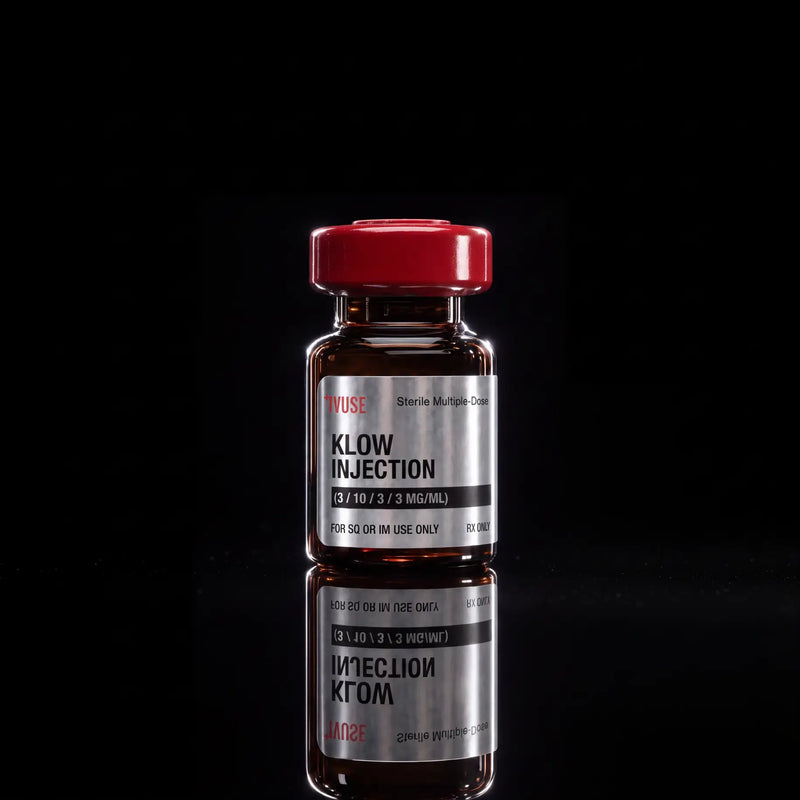
BPC-157, TB-500, GHK-Cu, KLOW.
Evidence: Tier 3. No published human randomized trials for BPC-157 or TB-500. The animal data on tendon, ligament, and gut tissue is substantial and genuinely interesting. GHK-Cu has real human data, but most of it is topical or in vitro rather than injectable.
What to expect
Repair peptides move faster than anything else in the catalog. People who respond usually notice something in two to four weeks, most often on a nagging tendon, a joint that complains, or gut symptoms. Standard protocols run four to eight weeks, then a break. Cycling here is clinical practice, not a merchandising device.
Skin runs on the opposite clock. Dermal turnover means GHK-Cu needs 8 to 12 weeks before you can evaluate it honestly, and photos in consistent lighting beat memory every single time. Texture and tone report before anything structural does.
What it won't do
Repair peptides won't rebuild a full tear. Structural damage is a surgical conversation. Signaling molecules don't close a rupture.
They won't work around load. If you keep doing the thing that injured you, nothing in a vial resolves that.
They won't show up on imaging. There's no way to confirm the mechanism is doing what you believe it's doing, and that's worth sitting with before you commit three months of budget.
GHK-Cu won't replace a retinoid or in-office resurfacing. Different mechanism, different depth, different result. It won't fill volume loss, which is a filler question, and it won't outrun sun damage you're still accumulating.
Nothing here produces a visible skin change in three weeks. Anyone showing you a three-week before-and-after is showing you lighting.
See KLOW Four repair peptides in one vial.
Peptides: Mind + Mood
SEMAX, SELANK, PT-141, Emideltide DSIP.
Evidence: Tier 1 for PT-141, approved in its branded form for low sexual desire in premenopausal women. Tier 3 for SEMAX and SELANK, both developed and approved in Russia, where the research is largely Russian-language and hasn't been replicated in Western trials. Tier 3 for DSIP, identified in the 1970s with little modern human trial work since.
What to expect
This group is the fastest-acting on the shelf. SEMAX and SELANK, when they work, usually declare themselves within days. The effect is subtle and situational, closer to a clearer window than a stimulant hit, which is exactly why people expecting a stimulant conclude nothing happened.
PT-141 is dosed before an encounter rather than daily, with onset around 45 minutes to two hours. The trial improvements in desire were real, statistically significant, and modest. Roughly 40 percent of trial participants experienced nausea, and that's the most common reason people stop.
What it won't do
SEMAX and SELANK won't treat a diagnosed condition. Anxiety and attention disorders are a physician conversation and a properly indicated medication.
They won't compensate for sleep debt. Nothing does. This group in particular tends to mask a deficit rather than resolve it.
PT-141 won't produce an erection. It acts on desire pathways in the brain, not on blood flow. Wrong mechanism for that problem. It won't repair a relationship either, and it won't resolve desire loss rooted in exhaustion or resentment.
DSIP won't sedate you. It isn't a sleeping pill, and it won't fix sleep apnea, a phone in the bed, or a 4pm espresso.
Injectable supplements: the floor, not the ceiling
B12, NAD+, Nicotinamide Riboside, Glutathione, LIPO+, Carnitine, Folic Acid.
Evidence: Tier 1 for correcting a documented deficiency. Tier 2 for NR reliably raising NAD+ levels, which it does. Tier 3 for whether that translates into an outcome you can feel or measure.
What to expect
If you're low on B12, correction can feel obvious inside a week or two, and the effect is real. If your labs are already in range, expect very little, because there's no good evidence that additional B12 does anything for someone who's replete.
NAD+ and its precursors are the most speculative purchase in the catalog. Some people report a real energy shift in the first few weeks. Many report nothing. Injected quickly, NAD+ produces flushing and a brief chest tightness in a lot of people, which is why the protocol says inject slowly.
What it won't do
Lipotropics won't burn fat. LIPO+ and carnitine support the pathways that metabolize fat. They don't create the deficit that requires it. Without one, they have nothing to do.
Glutathione won't reliably lighten your skin. The antioxidant role is well established. The evidence for injectable glutathione as a brightening agent is limited and drawn mostly from small studies.
Raising a biomarker isn't the same as changing an outcome. NR reliably raises NAD+ in blood. Whether that extends anything in humans hasn't been demonstrated. That distinction is the entire longevity category in one sentence.
None of these outperform a decent diet in someone whose labs are normal. Test first, then dose. Dosing blind and hoping is how this category earned its reputation.
See the injectable catalog Seven compounds, full protocol on every vial.
Realistic timelines, side by side
The number that matters is the evaluation window: how long before you can fairly judge whether something is working.
GLP-1 medications. Appetite in 1 to 2 weeks. Scale in 6 to 12 weeks. Full dose at 4 to 5 months. Honest evaluation at 6 months.
Repair peptides (BPC-157, TB-500, KLOW). First reports in 2 to 4 weeks. Full cycle 4 to 8 weeks, then a break.
Skin (GHK-Cu, KLOW). Nothing meaningful before week 6. Honest evaluation at 8 to 12 weeks. Three months minimum before you decide.
Growth hormone secretagogues (Ipamorelin, CJC-1295, Sermorelin, Tesamorelin). Sleep quality in 2 to 4 weeks. Body composition at 3 to 6 months. Baseline IGF-1 labs, or you're guessing.
Cognitive (SEMAX, SELANK). Days, not weeks. If two weeks produce nothing, stop paying for it.
PT-141. Same session. Try it two or three times before drawing a conclusion.
Injectable supplements. Deficiency correction in 1 to 2 weeks. Everything else, 4 to 12 weeks and lower expectations.
There's a pattern worth internalizing: the categories that work fastest are the ones with the least human outcome data, and the categories with the most data work the slowest. That's not a coincidence, and it's useful to hold in your head when something promises a dramatic result in six days.
How you're billed
Three things about the money, none of which are the number.
GLP-1s are flat-rate and dose-independent. Your monthly price doesn't move as your clinician titrates you up, and medication, telehealth consultation, and shipping are included. Many programs raise the price at every dose increase. That's the thing to check anywhere you shop.
Peptides and injectables are a flat 30-day supply, paid once. No subscription, no auto-renewal. Cycling on and off is standard practice with most of these compounds, and a subscription creates pressure to stay on continuously when the protocol calls for a break. You finish a cycle, then you decide.
Run one thing correctly before you run three. If the budget is tight, a single vial at a full protocol for three months beats a three-vial stack at half dose for three weeks. Half-dosing a stack is the most expensive way to learn nothing, and it's the most common way a person spends real money in this category and concludes none of it works.
Current pricing sits on each product page and on the GLP-1 pricing page.
The honest picture
Three things determine whether any of this does anything, and none of them are the molecule.
Consistency beats dose. The woman who runs a modest protocol every week for six months outperforms the woman who runs an aggressive one for three weeks and quits. Every time, and it isn't close.
The unglamorous inputs still run the show. Protein, sleep, resistance training, sunscreen. Everything on this shelf amplifies a process. It doesn't start one.
You have to give it the real window. Skin needs twelve weeks. Body composition needs six months. Recovery peptides need four to eight. Judging any of it at week three is how a person cycles through four brands and concludes the whole category is a scam, when what happened is that nobody ever gave her the timeline.
A licensed clinician reviews every order before it ships. Some of these interact with medications, and some are a bad fit for a specific history. If you're told something isn't right for you, that's the review working.
References
- Wilding JPH, et al. Once-Weekly Semaglutide in Adults with Overweight or Obesity. New England Journal of Medicine, 2021. (STEP-1)
- Wilding JPH, et al. Weight regain and cardiometabolic effects after withdrawal of once-weekly semaglutide. Diabetes, Obesity and Metabolism, 2022. (STEP-1 extension)
- Jastreboff AM, et al. Tirzepatide Once Weekly for the Treatment of Obesity. New England Journal of Medicine, 2022. (SURMOUNT-1)
- Aronne LJ, et al. Tirzepatide as Compared with Semaglutide for the Treatment of Obesity. New England Journal of Medicine, 2025. (SURMOUNT-5, NCT05822830)
- Falutz J, et al. Metabolic effects of a growth hormone-releasing factor in patients with HIV. New England Journal of Medicine, 2007. (Tesamorelin)
- Kingsberg SA, et al. Bremelanotide for the Treatment of Hypoactive Sexual Desire Disorder. Obstetrics & Gynecology, 2019. (RECONNECT)
- Pickart L, Margolina A. Regenerative and Protective Actions of the GHK-Cu Peptide. International Journal of Molecular Sciences, 2018.
Educational content, not medical advice. Compounded medications are not FDA-approved and require a prescription. Individual results vary.
Frequently asked.
How long before I know if a peptide is working?
It depends on the pathway. Cognitive peptides like SEMAX and SELANK declare themselves in days. Repair peptides like BPC-157 and TB-500 usually report in two to four weeks. Skin compounds like GHK-Cu need eight to twelve weeks because dermal turnover does not move faster than that. Growth hormone secretagogues need three to six months for body composition. Judging any of these before their window closes gives you a wrong answer.
How long does it take for a GLP-1 to work?
Appetite changes usually appear within the first two weeks. Scale movement follows between weeks six and twelve. Because titration is monthly, you will not reach full dose for four to five months, which is the dose the clinical trials were actually measuring. Six months is the point at which you can fairly evaluate a GLP-1 protocol.
Are peptides FDA approved?
Some are. Tesamorelin has published trial data and an approved branded form, and bremelanotide, the molecule in PT-141, is approved for low sexual desire in premenopausal women. Most peptides in this catalog are research-grade compounds with published data and no formal FDA approval, prescribed through licensed clinical channels. BPC-157 was placed on the FDA Category 2 list under Section 503A in 2023, which restricts compounding for human use.
Can I take a peptide alongside a GLP-1?
Frequently, yes, and it is one of the more common protocols we see. GLP-1 medications act on appetite and gastric emptying. Most peptides act on entirely separate pathways, so the interaction profile is often favorable. Any combined protocol should be reviewed by a licensed clinician.
Will a GLP-1 make me lose muscle?
It can, and this is the most under-discussed part of the category. Depending on the study and the population, a quarter to 40 percent of total weight lost can come from lean tissue when resistance training and adequate protein intake are not in place. It is manageable, and managing it takes deliberate effort rather than hope.
What happens when I stop a GLP-1?
The published extension data from STEP-1 showed participants regained roughly two thirds of lost weight within a year of stopping. These medications work while you take them, the same way a blood pressure medication does. Maintenance dosing and a planned off-ramp are both legitimate strategies. Stopping abruptly with no plan is not.
Do I need labs before starting?
For injectable supplements, strongly yes. B12, folate, and related markers determine whether you will notice anything at all, and dosing into a normal lab result usually produces nothing. For growth hormone protocols, a baseline IGF-1 gives you something to measure against.
Why is there no subscription?
Peptides and injectable supplements are sold as a flat 30-day supply, paid once, with no auto-renewal. Cycling on and off is standard practice with most of these compounds, and a subscription creates pressure to stay on continuously when the protocol calls for a break. GLP-1 pricing is flat-rate and does not increase as your dose goes up.
What if nothing happens?
Sometimes the answer is dose, sometimes it is the wrong compound for the goal, and sometimes the evaluation window has not closed yet. And sometimes this particular molecule does not do anything for you, which is a real outcome that Tier 3 evidence predicts for a meaningful share of people. That is information, and it is cheaper to learn it in one cycle than across four brands.
