

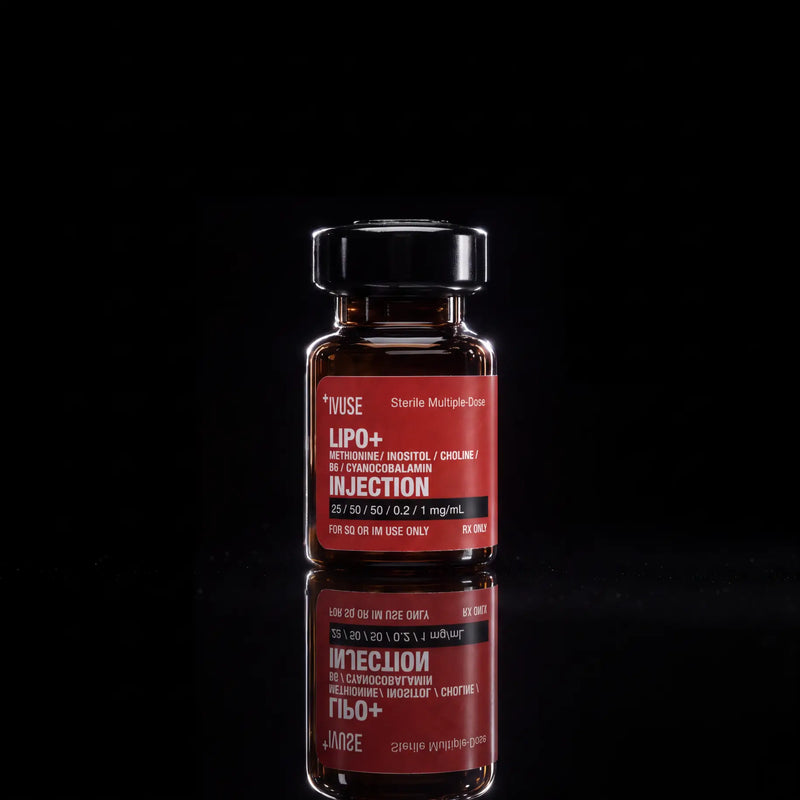
What Is AOD-9604?
A Peptide Guide for GLP-1 Plateaus
Medically reviewed by IVUSE+ Clinical Team

The first months on a GLP-1 do one specific thing with force. An appetite that felt immovable becomes negotiable. For women six, nine, twelve months into a protocol, the early chapters read like a different life. The snacking voice goes quiet. The scale moves. The clothes cooperate.
Then, somewhere around month nine, a different chapter begins.
The scale slows. The appetite is still handled, but the mirror starts asking new questions. Where has the loss actually come from? What is left to refine? And what happens now that the goal has quietly shifted from lose weight to look the way I want to look?
This is the moment AOD-9604 enters the conversation.
Quick answer: what is AOD-9604?
AOD-9604 is a synthetic peptide made from the last sixteen amino acids of human growth hormone, the portion responsible for fat metabolism. It was developed in Australia in the late 1990s to replicate the fat-burning signal of growth hormone without the effects on blood sugar, IGF-1, or tissue growth.
Unlike GLP-1 medications such as Ozempic, Wegovy, and Mounjaro, AOD-9604 does not suppress appetite. It acts directly on fat cells, prompting them to release stored fat and resist storing new fat.
Today, it is most commonly used as an adjunct to GLP-1 therapy, addressing the stubborn fat and body composition questions that surface after the initial weight loss phase has plateaued.
Key Takeaways
- AOD-9604 is a fragment of human growth hormone isolated for its fat-burning function.
- It targets stored fat by activating beta-3 adrenergic receptors on fat cells.
- It does not suppress appetite, does not affect blood glucose, and does not raise IGF-1.
- Phase II clinical trials showed modest standalone results, and development as a solo obesity drug was discontinued in 2007.
- Its current relevance is as a body composition tool used alongside GLP-1 protocols.
- It is not FDA approved for obesity. The FDA placed it on the Category 2 compounding list in late 2023.
A fragment, not a hormone.
AOD stands for Advanced Obesity Drug. The 9604 is a lab designation. The molecule itself is a synthetic fragment of human growth hormone, specifically the last sixteen amino acids of the hGH chain. Everything else got trimmed away.
This matters because human growth hormone is a broad instrument. It promotes cell division, lifts IGF-1, affects glucose, builds tissue. Some of those effects are desirable. Many are not. Researchers at Monash University in Australia, working in the late 1990s and early 2000s, asked a question with a precise edge. Could you keep the fat-burning signal and cut everything else loose?
AOD-9604 is the answer they built.
What makes it unusual is not power. It is restraint. It does not raise growth hormone levels. It does not raise IGF-1. It does not change blood glucose in any meaningful way. It does not suppress appetite. It does not interact with muscle growth pathways. It talks to a particular set of receptors on fat cells and asks them to release what they are holding. Nothing else.
How does AOD-9604 work?
AOD-9604 works by binding to beta-3 adrenergic receptors, a type of receptor found almost exclusively on fat tissue. Once engaged, these receptors trigger lipolysis, the process of breaking down stored triglycerides into free fatty acids the body can use for energy.
The mechanism has two parts working in parallel:
- It stimulates lipolysis. Fat cells release what they are storing.
- It inhibits lipogenesis. The body slows its creation of new fat cells.
Release what is there. Slow what is coming.
The practical consequence is that AOD-9604 tends to be discussed in the context of stubborn fat: the lower abdomen, the hips, the thighs. These areas have fat cells with a higher ratio of alpha-2 receptors (which resist release) to beta receptors (which permit it). They are the regions that do not respond to ordinary caloric deficit the way easier fat does. They are the last to go and the first to come back.
See the AOD-9604 protocol → A second lever for the phase after appetite. Prescribed through licensed clinical channels, under medical supervision.
AOD-9604 vs GLP-1s: the two levers.
If you are coming to AOD-9604 from a GLP-1 protocol, the clearest way to understand the relationship between the two is to stop thinking of them as alternatives. They are two levers on different halves of the same problem.
GLP-1s are input drugs. They act on the brain and the gut. They reduce appetite, slow gastric emptying, and recalibrate the hunger signal. They handle what goes in.
AOD-9604 is an output peptide. It acts on fat cells directly. It influences how the body releases and stores fat. It handles what is already there.
The two address different halves of the energy equation. Appetite and fat metabolism are not the same lever, and pressing one does not substitute for pressing the other.
Women who have hit a plateau on a GLP-1 are often told to go up in dose. Sometimes that works. Often it just adds side effects without moving the body composition needle, because the question was not really about appetite anymore. It was about what the body was doing with the fat it already had.
Stored by time. Released by science.
What does the research say about AOD-9604?
Transparency matters here, because AOD-9604 has a complicated clinical story and the internet tends to flatten it in both directions.
The molecule was developed by a company called Metabolic Pharmaceuticals. It went through Phase II trials in the mid-2000s with close to a thousand participants. The largest twelve-week study showed that the AOD-9604 group lost roughly 2.6 kilograms on average, compared to 0.8 kilograms for placebo. That is a real, statistically significant difference. It is also, by the standards of semaglutide or tirzepatide, modest.
Longer trials did not show the same magnitude of benefit, and development of AOD-9604 as a standalone obesity drug was discontinued in 2007. It did not become the blockbuster weight loss medication it was originally positioned as.
What the standalone data does not capture is the use case that has emerged almost twenty years later: AOD-9604 as an adjunct, not as a primary intervention. The original trials tested it against placebo in people who were not already in a caloric deficit, not already on appetite-modifying medication, not already into the composition phase of a protocol.
The modern question is different. It is not can this peptide produce weight loss on its own? It is can this peptide do something useful for a person whose appetite is already handled, who is already in a deficit, and who is now trying to influence body composition?
That is a different question, and the original trials were not designed to answer it.
Is AOD-9604 safe?
AOD-9604 has an unusually clean safety record in the peptide category. Across Phase I and Phase II trials involving roughly 900 participants, there were no reports of hepatotoxicity, no meaningful impact on fasting glucose or insulin sensitivity, and no serious adverse events at therapeutic doses.
The most commonly reported side effects have been mild: transient injection site irritation, occasional headache, and short-lived water retention in the first weeks of use.
Two things to know clearly:
- AOD-9604 is not FDA approved as a weight loss drug. In late 2023, the FDA placed it on its Category 2 list under Section 503A, which restricts compounding for human use.
- Safety data is strongest at researched doses and durations. Long-term, large-population data on the modern adjunct use case does not yet exist.
Any use of AOD-9604 should happen under medical supervision, with a qualified provider reviewing personal history and monitoring progress.
Who is AOD-9604 for?
AOD-9604 is not for someone just beginning a weight loss journey. The research is clear that as a primary intervention, it underperforms. If the goal is to lose significant weight from a starting point of no intervention, there are more effective tools.
Where it becomes relevant is for the woman who is already past the first phase.
The GLP-1 protocol worked. The appetite got handled. The early weight came off. And now the conversation has changed. The scale matters less. The silhouette matters more. The lower belly that did not go with the first thirty pounds has become the project. The face looks different, but the shape below the neck is asking for a different kind of attention.
This is the phase where AOD-9604 is most coherent. Not as a replacement for anything. As a different instrument, for the work a GLP-1 was not written to do.
The honest picture.
AOD-9604 is not a shortcut. It does not suppress appetite, so it cannot drive weight loss without an existing caloric deficit. It does not build muscle, so it cannot substitute for resistance training. It does not melt fat off the body the way influencer copy sometimes suggests. It asks fat cells to release what is stored. If there is no demand for that released energy, the energy goes back.
What it can do is change the texture of a plateau. It can give stubborn fat a reason to participate. It can work alongside a GLP-1 in a way that does not ask the GLP-1 to do more than it is designed to do. It can serve as a second lever when the first lever has gone as far as it is going to go on its own.
Frequently asked.
Is AOD-9604 FDA approved?
No. AOD-9604 is not FDA approved for weight loss or any other indication. In late 2023, the FDA placed it on its Category 2 list under Section 503A, which restricts compounding for human use. It continues to be prescribed through licensed clinical channels and compounding pharmacies under medical supervision.
Can you take AOD-9604 with Ozempic, Wegovy, or Mounjaro?
AOD-9604 is most commonly used today as an adjunct to GLP-1 medications, including semaglutide (Ozempic, Wegovy) and tirzepatide (Mounjaro, Zepbound). The two work through entirely different mechanisms, and because AOD-9604 does not affect appetite, blood sugar, or gastric emptying, the interaction profile is considered favorable. Any combined protocol should be overseen by a licensed clinician.
Does AOD-9604 suppress appetite?
No. AOD-9604 does not act on appetite pathways. This is one of its defining features and the reason it is considered complementary to GLP-1 therapy rather than redundant with it. GLP-1 medications manage appetite. AOD-9604 addresses how the body releases stored fat.
What are the side effects of AOD-9604?
Reported side effects have been mild across clinical studies. The most common include temporary injection site redness or irritation, mild headaches (often linked to hydration), brief water retention in the first weeks of use, and occasional nausea when injected on an empty stomach. No serious adverse events have been documented in the clinical record at therapeutic doses.
How long does AOD-9604 take to work?
Most clinicians describe a timeline of two to three weeks before early effects become noticeable, with more pronounced body composition changes accumulating across a full eight to twelve week protocol. Results depend heavily on the underlying conditions: a caloric deficit, resistance training, adequate protein, and adequate sleep.
Is AOD-9604 the same as HGH?
No. AOD-9604 is a small fragment of the human growth hormone molecule, specifically the sixteen amino acids responsible for fat metabolism. It does not raise IGF-1, does not affect blood glucose, and does not trigger the broader growth signals of full HGH. It was specifically engineered to isolate the lipolytic function of growth hormone and leave everything else behind.
Does AOD-9604 cause muscle loss?
No. AOD-9604 does not act on muscle tissue. By enhancing fat mobilization during a caloric deficit, it may actually support lean tissue preservation, since more of the body's energy needs are drawn from fat stores rather than muscle. It is not a substitute for resistance training, but it does not oppose it.


